

Urdu Phonetic Keyboard

The Urdu phonetic keyboard is very important and can help a lot of people to learn how to speak this language. It’s used in many parts of India and Pakistan. It has been improved a lot in modern times.
Language is spoken in many parts of India
Urdu and Hindi share common grammar and vocabulary, but they are not exactly the same. There are several ways of comparing the two. However, for this post, we will look at the more common phonological, semantic, and formal characteristics of the two languages.
The most important difference is that Hindi and Urdu are written in different scripts. Most written records in pre-modern India are in the form of inscriptions, but the printing press changed the way we view and distribute text.
The simplest way to compare the two is to think of them in terms of their respective phonologies. Specifically, Urdu is a Persianised version of the Hindustani language. It is also an adaptation of the Arabic script. In addition, the script is similar to the Devnagari script. It has vertical bars and straight lines.
The most useful glyphs in the Hindi alphabet are the consonant diacritics, which appear above or below each consonant letter. They are usually placed on the Shift layout.
Language is spoken in Pakistan
Urdu phonetic keyboard is a great tool to make writing Urdu simple and easy. It’s great for English keyboard users too.
Urdu has been around for centuries and is spoken by millions of people all over the world. As of 2021, it is the 21st largest language in the world. It is the official language of Pakistan. Moreover, it is a very popular language in India and some parts of South Asia.
Urdu is a simple language to learn. However, it does have a fair amount of sophistication. It is important to know how to write in Urdu correctly if you wish to communicate with other people using it. Some online Urdu Phonetic typing tutors are available to help you with your typing woes.
For instance, the CRULP Urdu Phonetic Keyboard Layout v1.1 has been designed to make it easy to type in Urdu. It also features three different faces. The first two levels of the layout feature the basic Urdu characters placed on standard keyboard positions.
Evolution of the language
The Urdu phonetic keyboard allows you to learn the correct way to write Urdu. If you don’t know how to type Urdu, or you want to try it again, you can easily install the Urdu phonetic keyboard by clicking the link below.
The keyboard is an extension of the InPage phonetic keyboard. InPage is a popular commercial desktop publishing application for Urdu. It supports Urdu natively on Windows OS 8. x. InPage also includes diacritical marks. You can use the keys to enter the letters and numbers, as well as add mathematical symbols via option-shift key combinations.
There are 39 letters in the Urdu alphabet. Most are a combination of vowels and consonants. There are only a few that have prominent vertical elements. For example, the “BaRi Yay” y is used for a decorative calligraphic effect. It is visually similar to “ChoTi Yay” y. It is also used in decorative writing.
The letter “W” is pronounced in Urdu as a consonant “v” at the beginning of a syllable and is often transcribed as “yh” in Hindi. It is also pronounced as a consonant in Arabic words. However, when the “w” is alone, it creates ambiguity that can cause errors.
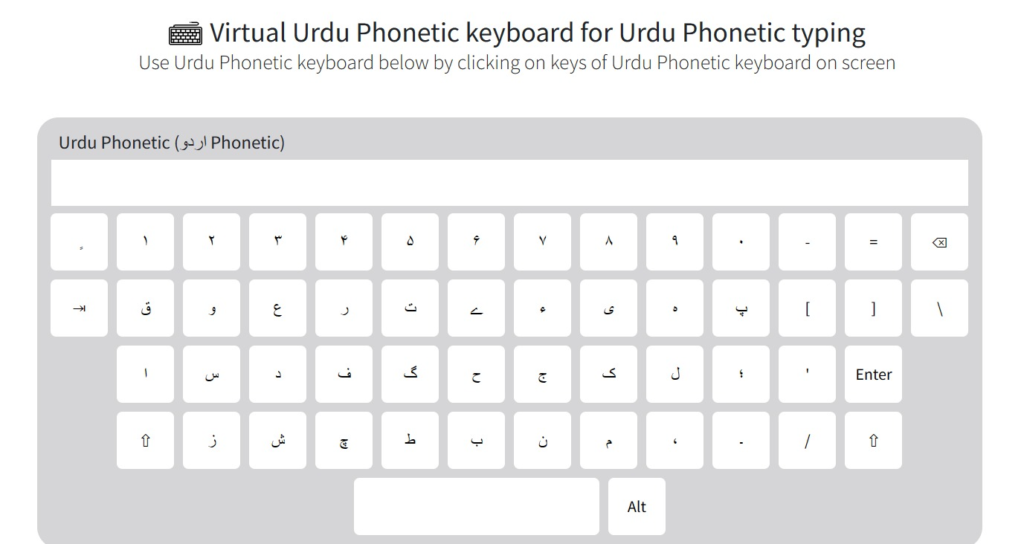
Urdu Phonetic keyboard – Type in Urdu Phonetic online (contenttool.io)
Modern improvements in the language
Modern improvements in the Urdu phonetic keyboard have resulted in improved textual efficiency through electronic media. However, this has left the language lagging behind in the digital age. As such, speakers of the language must put pressure on major tech platforms and educate new generations. To do so, they must include veteran practitioners and also reach out to younger generations.
Urdu, which is the official language of Pakistan, has benefited from improved keyboards. But, despite these changes, the problem of the Urdu typeface remains. Although the problem has been solved in theory, it still poses a significant linguistic extinction.
The National Language Authority started a research project to standardize the encoding of the Urdu script. It also developed a new keyboard layout for typewriters. The first version of the keyboard was developed in 1999. It incorporated 46 keys to type 71 Urdu characters. It was adopted for word processors and computer-based applications.
During the early days of the internet, it was nearly impossible to type in the Urdu script. Urdu publications were written by hand in Pakistan until the 1980s. Nevertheless, language played a key role in the independence movement. As a result, it was adopted as the official language of Pakistan in 1951.